The amazing Rene Stange added USB Gadget (i.e. device) support to the Circle bare metal Raspberry Pi environment a while ago so I’ve now incorporated that into MiniDexed. This allows MiniDexed to be used as a USB device – i.e. it can just be plugged into a PC and used via USB MIDI directly, as long as your Raspberry Pi supports USB Gadget mode and you have some means of audio output.
This post looks at how to make a “USB dongle” that is basically a USB MIDI accessible DX7.
A quite note before I start however. Why would someone want to do this? There are several VST DX instruments for PCs if you want DX sounds in your DAW and Dexed itself gives you full access to a DX7 via a software interface.
So there is probably very little practical reason to do this. But personally, I just couldn’t resist the idea of having a plug-in DX7 on a USB stick!
Warning! I strongly recommend using old or second hand equipment for your experiments. I am not responsible for any damage to expensive instruments!
These are the key tutorials for the main concepts used in this project:
If you are new to microcontrollers and single board computers, see the Getting Started pages.
Parts list
- Raspberry Pi Zero, Zero W or Zero W2.
- I2S or alternative audio output for a Pi Zero.
- USB “STEM”, “Zero Dongle” or other USB device connection (micro USB to USB A).
Note: the Pi Zero and Zero W will give access to a single MiniDexed tone generator. The Pi Zero W2, will support 8 tone generators.
Warning: When using a Raspberry Pi in USB Gadget mode, do not plug in its usual power supply! It should be USB “bus powered” only.
The Hardware
Whilst any Raspberry Pi that supports USB Gadget mode could be used with a suitable lead to power and link to MiniDexed, to make a USB “dongle” requires the use of a Pi Zero (any flavour) and a “dongle style” add on.
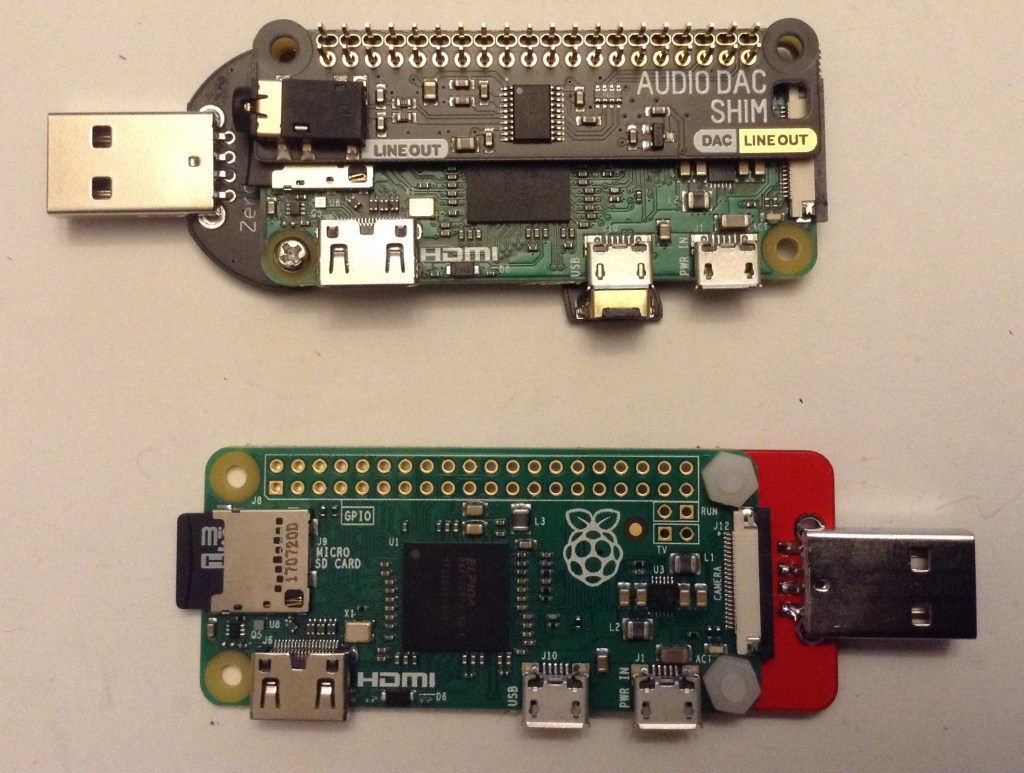
I’ve used the following:
It will also need a means of outputting audio from the Zero as MiniDexed only supports USB MIDI, not USB audio.
There are several options for audio out on a Pi Zero. By far the easiest is some kind of off-the-shelf I2S audio interface.
A really good, low-profile one ideal for use as a dongle is the Pimoroni Audio SHIM, which can be found here. It doesn’t even need soldering, it can push-fit over the Pi’s GPIO headers, but any I2S audio interface for the Pi can be used as long it doesn’t interfere with the USB plug for the “dongle”.
My ideal combination is the USB STEM and the Pimoroni Audio SHIM as it is both low-profile and has the USB plug at one end and the audio output at the other. But it does have to be soldered on.
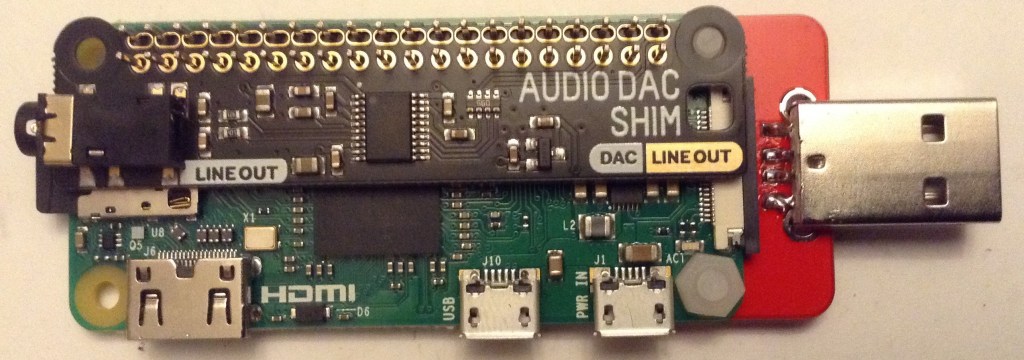
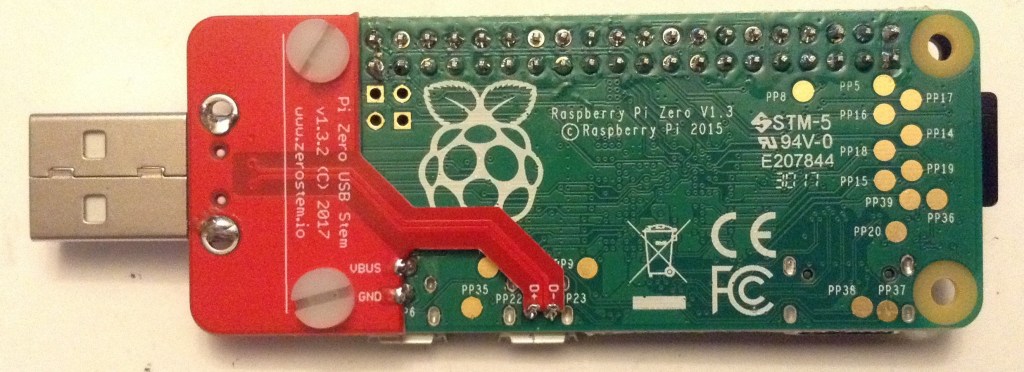
The cheap adaptor board has the advantage of using spring-loaded connectors, so no soldering is required, although the PCB is very thin, so I don’t know how long it would last.
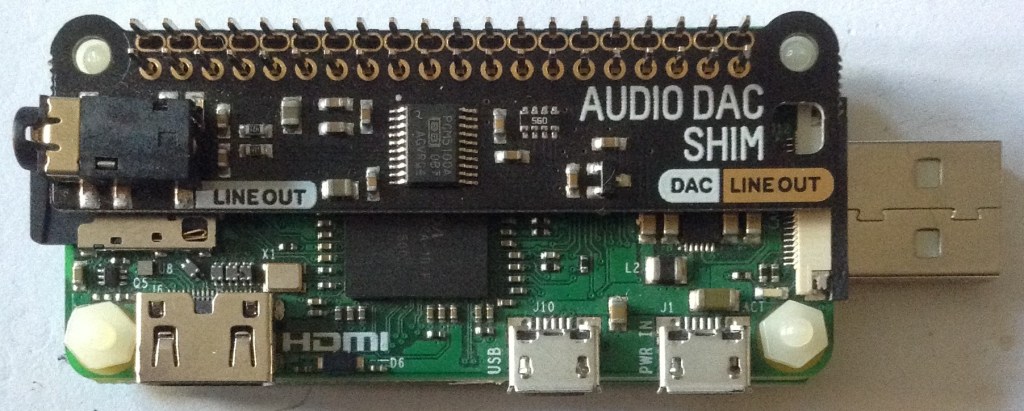
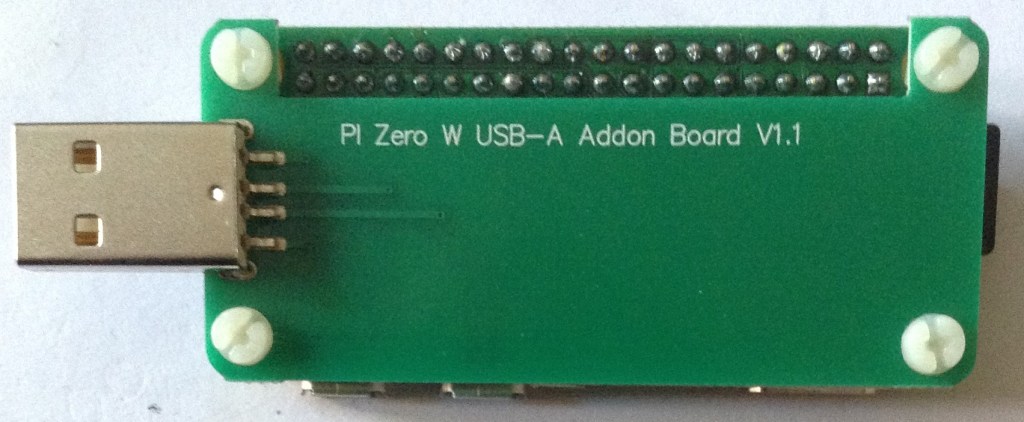
The 8086 solderless dongle is a neat solution, but whilst it works, the combination of location of the audio output and USB plug isn’t great. I’d have preferred it to be the other way round.
But it seems a lot more robust for a solderless solution than the cheap adaptor board.
MiniDexed Configuration
Hopefully by the time you read this, USB Gadget support in MiniDexed will be merged into the main code (it is PR567). Details of how to configure it can be found on the wiki here, but the key MiniDexed configuration (minidexed.ini) required for this configuration is as follows:
USBGadget=1
SoundDevice=i2s
The rest of the configuration is largely ignored, but things like the LCD, buttons and encoder can simply be disabled (set to 0) as they are not required.
A Single DX7
As mentioned previously if using a Zero V1/W then a single tone generator is available. The MIDI channel it uses will be as defined in the default performance.ini file. It is set to OMNI by default. To change it, change:
MIDIChannel1=<MIDI channel 1 to 16>
The default MIDI configuration for MiniDexed assumes voice changes will be made with a combination of bank select Control Change and Program Change messages with each bank containing 32 voices. But the following configuration allows four banks to be spread across all 128 Program Change values:
ExpandPCAcrossBanks=1
When plugged into a PC it will come up as “MIDI Gadget” as a USB MIDI compatible device. Here it can be seen in MidiOx, being selected as the MIDI output.
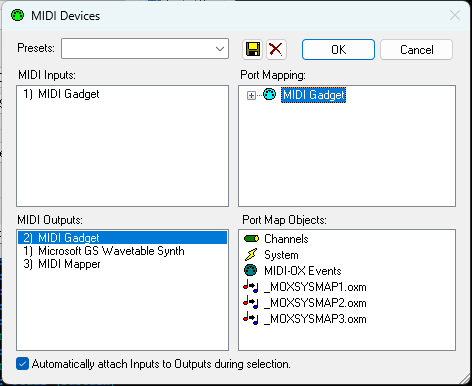
This configuration assumes you’ve installed ROMS 1a, 1b, 2a and 2b at least (details here) in your sysex/voices directory on the SD card.
I have a MidiOx instrument file with all the voices for Roms 1a/1b/2a/2b/3a/3b/4a/4b selectable via Bank Select messages, and Roms 1a+1b+2a+2b configured for use as a single 128-voice bank via Program Change messages.
Find it on GitHub here. This needs to be copied to the “instr” directory of the MidiOx installation.
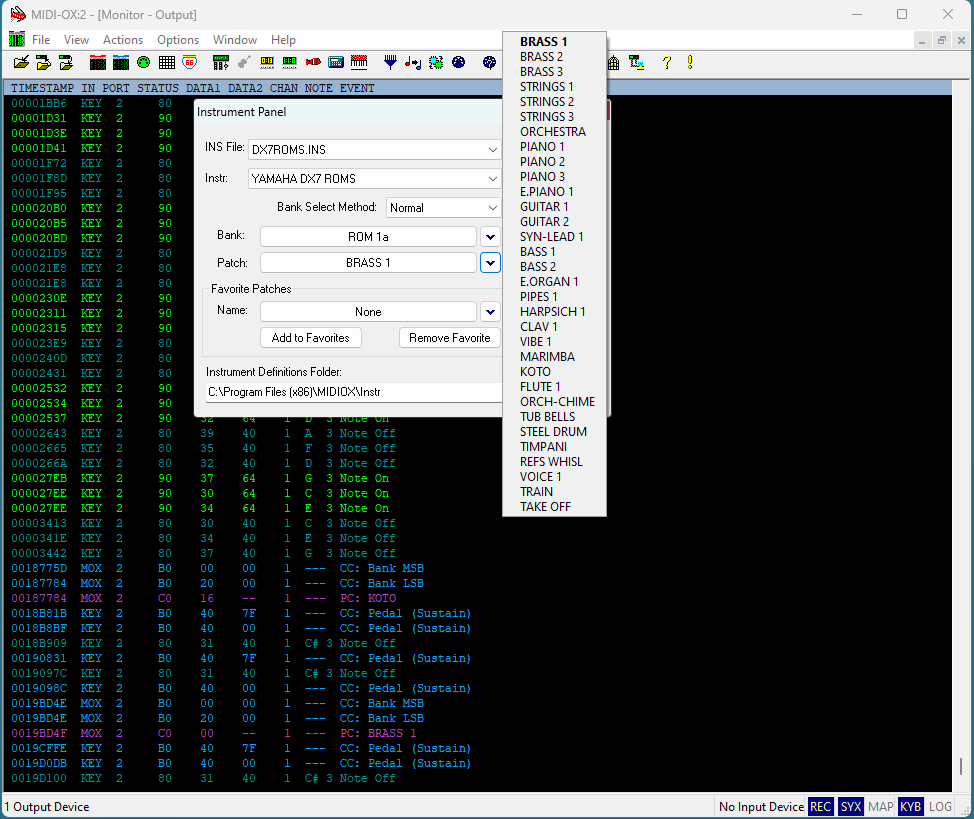
In MidiOx, View -> Instrument Panel, select “INS File: DX7ROMS.INS” and then choose one of the following for “instr”:
- “YAMAHA DX7 ROMS” for the individually selectable 8 ROMs.
- “YAMAHA DX7 VOICES” for the first four ROMs to be linked as a 128-voice single bank.
Both views (and voice selections) are shown below.

An 8-DX7 Instrument
If using a Zero 2W then 8 tone generators are available. In that case there is a choice. It can be treated as eight independent tone generators, in which case the MIDI channels for each TG should be set independently.
The following configures TGs 1-8 for MIDI channels 1-8.
MIDIChannel1=1
MIDIChannel2=2
MIDIChannel3=3
...
MIDIChannel8=8
At this point, the MIDI interface is the same as before, but changing the MIDI channel will change the tone generator being used.
Alternatively, it is possible to now treat the 8-way TG MiniDexed as a single instrument with much more complex sounds.
If the following setting is enabled in minidexed.ini:
PerformanceSelectChannel=1
This will interpret Program Change messages on MIDI channel 1 as selecting “performances”. Each “performance” is a configuration of up to 8 tone generators with a range of voices and effets.
The full list of default “performances” can be sound by browsing the MiniDexed github repository here.
Once again I’ve added a mode in my MIDIOx instrument file to support performances:

Warning: There is a proviso with this configuration.
At present, MiniDexed loads performances into consecutive “slots” meaning that the numbers in the MiniDexed repository do not relate to the “patch numbers” used over MIDI. The MIDIOx file supports the files in the repository at the time of writing. If new performances are added in some of the gaps (and there are gaps) in the numbering, then the names will be out of sync with what is installed.
Personally I think we need to change this and make the numbers relate to the MIDI program numbers. Watch this space!
Closing Thoughts
As mentioned in the introduction, with a good selection of software synths available that provide a DX7 on a computer for use with a DAW, there is limited use for a “DX7 on a USB stick”.
But I still think this is a pretty neat thing to be able to do, if nothing else, just for the fun of knowing that a $2000 synth from the 1980s can now be replicated with ~$20 worth of hardware that can be plugged into any PC and just “played”.
Kevin

 Simple DIY Electronic Music Projects
@diyelectromusic.wordpress.com This shows how to build a "DX7 USB Dongle" using #MiniDexed on a @Raspberry_Pi Zero.
LikeLike
Remote Reply
Original Comment URL
Your Profile
Why do I need to enter my profile?
This site is part of the ⁂ open social web, a network of interconnected social platforms (like Mastodon, Pixelfed, Friendica, and others). Unlike centralized social media, your account lives on a platform of your choice, and you can interact with people across different platforms.
By entering your profile, we can send you to your account where you can complete this action.
@diyelectromusic.wordpress.com I love this. I have a zero 2 I can use for it.
LikeLiked by 1 person
Remote Reply
Original Comment URL
Your Profile
Why do I need to enter my profile?
This site is part of the ⁂ open social web, a network of interconnected social platforms (like Mastodon, Pixelfed, Friendica, and others). Unlike centralized social media, your account lives on a platform of your choice, and you can interact with people across different platforms.
By entering your profile, we can send you to your account where you can complete this action.
@diyelectromusic.wordpress.com This is now merged into the main build of MiniDexed :)Full details here: https://github.com/probonopd/MiniDexed/wiki/Hardware#usb-gadget-mode
LikeLike
Remote Reply
Original Comment URL
Your Profile
Why do I need to enter my profile?
This site is part of the ⁂ open social web, a network of interconnected social platforms (like Mastodon, Pixelfed, Friendica, and others). Unlike centralized social media, your account lives on a platform of your choice, and you can interact with people across different platforms.
By entering your profile, we can send you to your account where you can complete this action.